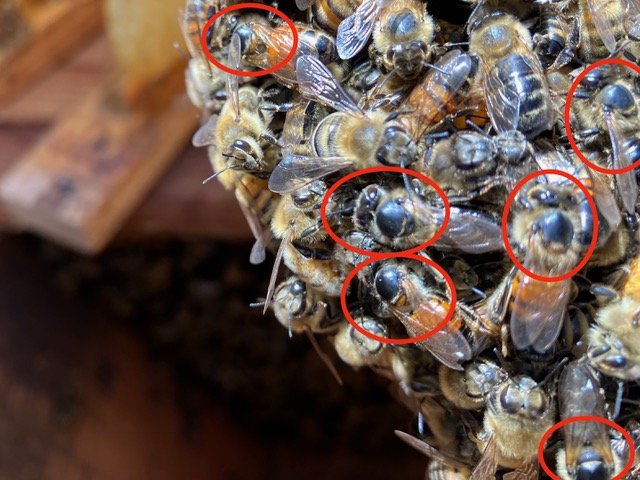
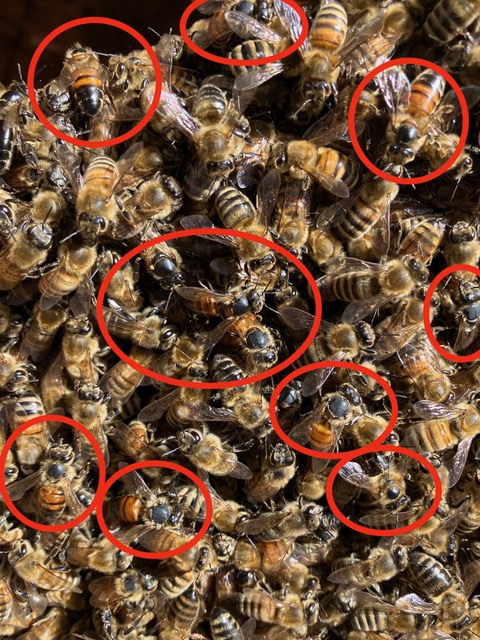
Recently I was called to help a beekeeper in the Las Campanas area figure out what was killing her bees. Upon inspection there were many hairless shiny bees with hairless black thoraxes as shown in the photos, and we found these infected bees in 3 colonies. One colony was severely infected with hundreds of dead bees inside and outside the hive. These were established colonies that had overwintered successfully. There had been no new queens, nucs or packages introduced into the bee yard. This is most likely Chronic Bee Paralysis Virus (CBPV). There are several paralytic bee viruses, it is hard to distinguish between them unless a laboratory can test for molecular pathogen loads. Infected bees were observed last year in a colony in central Santa Fe from a package of bees in the spring (the bees did recover), and have also been observed this year in south Santa Fe around the Country Club. 

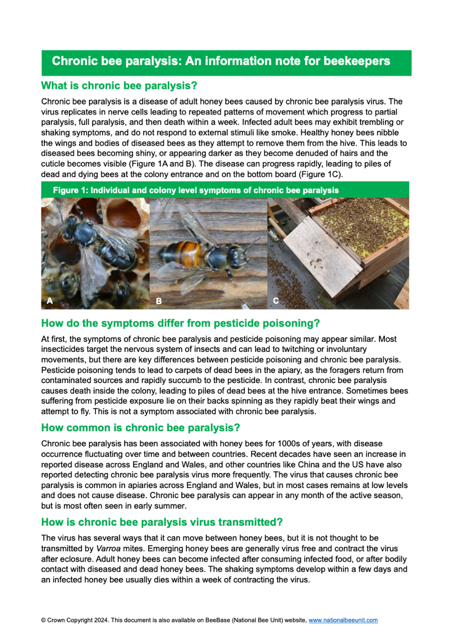
I spoke with Amy Rogers of Desert Hives who does the annual honeybee testing for the New Mexico Dept. of Agriculture and the National Honey Bee Disease Survey. Honey bee samples collected in New Mexico in October of 2025 contained Chronic Bee Paralysis Virus so it’s been in New Mexico but everyone needs to be on the alert and recognize symptoms in their hives. Here’s some info about it:
https://www.nationalbeeunit.com/assets/PDFs/3_Resources_for_beekeepers/Fact_Sheets/Fact_10_Chronic_Bee_Paralysis_Virus.pdf Fact_10_Chronic_Bee_Paralysis_Virus PDF Document · 507 KB Chronic bee paralysis virus https://idtools.org/thebeemd/index.cfm?packageID=1180&entityID=8365 Bees who are weakened by varroa mites are more susceptible to viruses so it’s important to control mites.
Interesting fact: Virus-infected honeybees are more likely to gain entrance to healthy hives https://news.illinois.edu/virus-infected-honey-bees-more-likely-to-gain-entr...
Fact sheets about other bee viruses: Acute bee paralysis virus. https://idtools.org/thebeemd/index.cfm?packageID=1180&entityID=8321 Israeli acute paralysis virus. https://idtools.org/thebeemd/index.cfm?packageID=1180&entityID=8442 Kashmir bee virus https <https://idtools.org/thebeemd/index.cfm?packageID=1180&entityID=8443>://idtools.org/thebeemd/index.cfm?packageID=1180&entityID=8443 <https://idtools.org/thebeemd/index.cfm?packageID=1180&entityID=8443> Deformed Wing Virus https://idtools.org/thebeemd/index.cfm?packageID=1180&entityID=8386
Chronic bee paralysis as a serious emerging threat to honeybees https://www.nature.com/articles/s41467-020-15919-0 Chronic bee paralysis as a serious emerging threat to honey bees - Nature Communications nature.com
Identification Technology Program has fact sheets for help with identifying pathogens. TP is a collaborative project between the United States Department of Agriculture (USDA) Animal and Plant Health Inspection Service (APHIS) Plant Protection and Quarantine (PPQ) Science & Technology (S&T) Pest Identification Technology Lab (PITL), Colorado State University Department of Biology, North Carolina State University Center for Integrated Pest Management, and University of Georgia Center for Invasive Species and Ecosystem Health.