
I also find the closing of the Beltsville Bee Lab disturbing. Many of us have submitted bee and comb samples to the Beltsville Lab for help in identifying disease. This is a free service and there is no redundancy here—no other agency provides this service and we have nothing comparable in the state of New Mexico. Many other periodicals have covered this story including Bee Culture and The American Bee Journal. This is absolutely a topic of interest to beekeepers, please read the letter of concern below explaining why this Bee Lab is so important. Please refrain from personal attacks. Your moderator, Kate
Begin forwarded message:
From: Jerry Hayes | Editor | Bee Culture Magazine <jerry@beeculture.com> Subject: Support For the Beltsville Research Lab 9.11.25 Date: September 11, 2025 at 11:02:58 AM MDT To: beto1234@earthlink.net Reply-To: Jerry Hayes | Editor | Bee Culture Magazine <jerry@beeculture.com>
Trouble seeing this email? Click here to view email in browser <https://kalng9.fd58.fdske.com/e/c/01k4wvnxp4sgbncrvjdh9rqqr3/01k4wvnxp4sgbncrvjdhx9sp1p>
<https://kalng9.fd58.fdske.com/e/c/01k4wvnxp4sgbncrvjdh9rqqr3/01k4wvnxp4sgbncrvjdjdrjwr8>
Click below to read all the BUZZ! SUPPORT FOR BELTSVILLE RESEARCH LAB <https://kalng9.fd58.fdske.com/e/c/01k4wvnxp4sgbncrvjdh9rqqr3/01k4wvnxp4sgbncrvjdp09t925> This letter was sent out by the Honey Bee Health Coalition at the end of August in support of the Beltsville Research Lab.
To Whom it May Concern, On behalf of the Honey Bee Health Coalition and the undersigned, we are reaching out to offer our collective support in safeguarding the future of the USDA-ARS Bee Research Laboratory (BRL), part of the Beltsville Agricultural Research Center (BARC) in Beltsville, Maryland. Recently, USDA announced the potential closure of BARC as part of a broader agency reorganization plan. The BRL is an internationally recognized leader in honey bee health research and diagnostics. Its work is essential to identifying and addressing the diseases and stressors that threaten managed honey bees, while leading national efforts to combat severe colony losses. These efforts are not only scientifically critical but also economically vital: honey bees contribute more than $20 billion annually to the U.S. economy by pollinating nearly one-third of the food we eat—including fruits, vegetables, nuts, and seeds. This year, honey bee colony losses have reached record levels, with disease continuing to play a major role. Closure or relocation of the BRL would severely disrupt ongoing research and undermine its indispensable Bee Disease Diagnostic Service, which supports beekeepers nationwide. CLICK HERE TO READ THE FULL LETTER <https://kalng9.fd58.fdske.com/e/c/01k4wvnxp4sgbncrvjdh9rqqr3/01k4wvnxp4sgbncrvjdr4w2y1g>
https://docs.google.com/document/d/1VbTtU1tH4MxiRdwpK4J6U4LT-ie9LNFeNCYd14nnOwc/edit?tab=t.0 Letter of concern regarding proposed relocation of USDA Beltsville Bee Lab docs.google.com
August 20, 2025
The Honorable Brooke Rollins Secretary of Agriculture of the United States U.S. Department of Agriculture 1400 Independence Ave. Washington, D.C. 20250
The Honorable Stephen Vaden Deputy Secretary of Agriculture of the United States U.S. Department of Agriculture 1400 Independence Ave. Washington, D.C. 20250
Dear Secretary Rollins and Deputy Secretary Vaden,
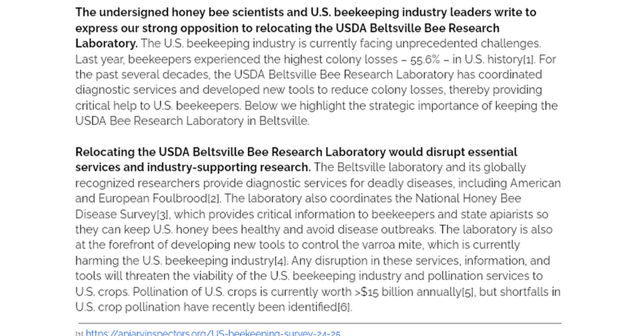
The undersigned honey bee scientists and U.S. beekeeping industry leaders write to express our strong opposition to relocating the USDA Beltsville Bee Research Laboratory. The U.S. beekeeping industry is currently facing unprecedented challenges. Last year, beekeepers experienced the highest colony losses – 55.6% – in U.S. history[1]. For the past several decades, the USDA Beltsville Bee Research Laboratory has coordinated diagnostic services and developed new tools to reduce colony losses, thereby providing critical help to U.S. beekeepers. Below we highlight the strategic importance of keeping the USDA Bee Research Laboratory in Beltsville.
Relocating the USDA Beltsville Bee Research Laboratory would disrupt essential services and industry-supporting research. The Beltsville laboratory and its globally recognized researchers provide diagnostic services for deadly diseases, including American and European Foulbrood[2]. The laboratory also coordinates the National Honey Bee Disease Survey[3], which provides critical information to beekeepers and state apiarists so they can keep U.S. honey bees healthy and avoid disease outbreaks. The laboratory is also at the forefront of developing new tools to control the varroa mite, which is currently harming the U.S. beekeeping industry[4]. Any disruption in these services, information, and tools will threaten the viability of the U.S. beekeeping industry and pollination services to U.S. crops. Pollination of U.S. crops is currently worth >$15 billion annually[5], but shortfalls in U.S. crop pollination have recently been identified[6].
[1] https://apiaryinspectors.org/US-beekeeping-survey-24-25 <https://apiaryinspectors.org/US-beekeeping-survey-24-25> [2] https://www.ars.usda.gov/northeast-area/beltsville-md-barc/beltsville-agricu... <https://www.ars.usda.gov/northeast-area/beltsville-md-barc/beltsville-agricultural-research-center/bee-research-laboratory/docs/bee-disease-diagnosis-service/> earch-laboratory/docs/bee-disease-diagnosis-service/ <https://www.ars.usda.gov/northeast-area/beltsville-md-barc/beltsville-agricultural-research-center/bee-research-laboratory/docs/bee-disease-diagnosis-service/>
[3] https://www.aphis.usda.gov/plant-pests-diseases/honey-bee-surveys <https://www.aphis.usda.gov/plant-pests-diseases/honey-bee-surveys> [4] https://www.biorxiv.org/content/10.1101/2025.05.28.656706v1 <https://www.biorxiv.org/content/10.1101/2025.05.28.656706v1> [5] https://doi.org/10.1371/journal.pone.0037235 <https://doi.org/10.1371/journal.pone.0037235> [6] https://doi.org/10.1098/rspb.2020.0922 <https://doi.org/10.1098/rspb.2020.0922> Beltsville offers a low-risk environment for disease spillover, enabling controlled study of high-risk honey bee pathogens. Situated away from major commercial beekeeping centers, Beltsville offers strategic isolation and biosecurity. Relocating the laboratory to a high-density beekeeping state would jeopardize containment measures and increase the risk of introducing harmful agents into the nation’s bee populations.
Beltsville’s four distinct seasons – unlike the milder climates of other USDA-ARS bee research locations – provide important conditions for studying overwintering losses. Overwinter mortality, seasonal disease dynamics, and the broader impacts of climate on colony health, remain primary drivers of annual colony losses. The Mid-Atlantic climate is broadly representative of the environmental conditions faced by most U.S. beekeepers. Thus, the geographical location of Beltsville provides environmental conditions that are ideal for understanding stresses on the U.S. beekeeping industry.
Below, we share quotes from prominent U.S. beekeeping scientists and organizations that highlight the importance of maintaining the USDA Beltsville Bee Research Laboratory’s services, research, and expertise:
“The central tenet in business is location, location, and location, and the same holds true in honey bee research at the USDA-ARS Beltsville bee lab. Their central location of laboratory and clinical services has been indispensable to the apiculture industry for decades, and any disruption in those services would have negative ripple effects for beekeepers across the nation. The proximate location of the participating lab groups within the unit makes them hyper-efficient to respond quickly to urgent issues in the industry; breaking up the unit would greatly diminish their ability to do so. Beltsville is ideally situated to connect industry, university research, and policymakers to make substantial differences in the lives of beekeepers; there cannot be a more well-suited location for USDA honey bee research in the nation.” – David Tarpy, University Faculty Scholar Professor, North Carolina State University
“The USDA Beltsville Bee Lab has been a critical lab for many research trials and confirmations of products commercial beekeepers use or shouldn't use due to lack of efficacy. They have been the lab running the National Honey Bee Disease Survey, which is a great well of data for our industry. My home state of North Dakota’s Agriculture Department contributes to help this survey due to the critical Information it offers. We understand some of the Beltsville staff are willing to relocate, but as we have seen in other similar USDA relocations, we would lose half of the staff. For this reason, it would be best to maintain the lab, find a new lab there, or find a partnership with the University of Maryland.” – Chris Hiatt, Past President, American Honey Producers Association
“The USDA Bee Research lab in Beltsville has been a critical hub of research on our nation’s honey bees and a critical provider of diagnostic services on the diseases and parasites that affect the health of bees. Keeping bees healthy is vital to the pollination of American fruit, vegetable and almond crops and to the livelihood of beekeepers – the unsung heroes of agriculture.” – Marla Spivak, Professor Emeritus and McArthur Fellow, University of Minnesota
“Beekeepers across the United States rely on the services of the Beltsville Bee Lab and the research they provide. The results must be accurate and timely in order to assist us in making decisions that are critical to our industry. Beekeepers and our services are critical to food security in the U.S. and that requires healthy bees. A lab that works collaboratively with other researchers in the same location saves time and money for beekeepers as well as the government. We request that you rethink your decision to close/relocate this facility.” – Debbie Seib, Vice President, American Beekeeping Federation
“The USDA-ARS Beltsville Bee Research Laboratory (BRL) is an indispensable fixture of American apiculture. Its staff and scientists provide disease and pest diagnostic services for the nation’s beekeepers, conduct vital research on the impact and mitigation of honey bee colony stressors, and collaborate with a broad network of other scientists on topics of relevance to honey bee husbandry. For decades, the BRL has provided answers to beekeepers’ most pressing questions.” – Jamie Ellis, Gahan Endowed Professor, University of Florida
“The USDA Beltsville Bee Research Lab & its teams remain a point of prestige and excellence for American agriculture, providing core centralized expertise, co-ordination, and emergency response to our embattled American Beekeeping industry on which billions of dollars of specialty crops - and American farmers - rely. By providing centralized expertise and repositories, especially of agricultural bee diseases, its presence vastly improves the efficiency of USDA spending across the nation by preventing wasteful duplication of effort between states' bee labs. Closing it risks reducing the efficiency of government spending in support of safeguarding American fruit and vegetable production and consequently reducing American access to safe nutritious food on which the "Make America Healthy Again" agenda ultimately rests.” – Lewis Bartlett, Assistant Professor, University of Georgia
“The Beltsville Lab has been a cornerstone of honey bee research and the beekeeping industry, providing critical scientific insights that have shaped how we understand and respond to the challenges facing these important crop pollinators. Their work is essential not just to the health of honey bees, but to the stability of our entire agricultural system.” – Samantha Alger, Assistant Research Professor, University of Vermont
“The USDA Beltsville Bee Research Laboratory plays a vital role in advancing honey bee health and supporting beekeepers nationwide. The University of Nebraska–Lincoln (UNL) Bee Lab is proud to collaborate with Beltsville through the APHIS Honey Bee Health Survey, which provides critical data, diagnostic services, and insights to beekeepers in Nebraska, Kansas, and Missouri. Their diagnostic expertise and commitment to pollinator health are essential to our shared mission of sustaining healthy bee populations and supporting U.S. agriculture.”– Judy Wu-Smart, Associate Professor & Extension Specialist, University of Nebraska-Lincoln
“For over a century, the Beltsville USDA-ARS Bee Laboratory has been vital to US beekeeping, providing rapid responses during crises, decades of diagnostic services, and research uniquely enabled by its isolated apiary. The scientists, Drs. Chen, Evans, Corona, Cook and Alburaki, hold unmatched expertise and institutional knowledge that directly benefit beekeepers and agriculture nationwide. Closing this lab would undermine pollinator health, food production, and the livelihood of the US citizens. I strongly urge USDA leadership to keep the Beltsville Bee lab open in perpetuity.” – Elina Nino, Professor, University of California, Davis
As U.S. honey bee scientists and beekeeping industry leaders, we urge you to reconsider the proposed relocation of the USDA Beltsville Bee Research Laboratory. Relocating the lab would likely result in immediate and long-term harm to the U.S. beekeeping industry, thereby compromising essential pollination services to U.S. agriculture.
Sincerely,
*Signatures in this letter to not represent official positions or views of their institutions.
David Tarpy, Professor Department of Applied Ecology North Carolina State University, NC, USA Patty Sundberg, President American Beekeeping Federation Columbus, MT, USA Chris Hiatt, Past President American Honey Producers Association Bowman, ND, USA Marla Spivak, Professor Emeritus Department of Entomology University of Minnesota, MN, USA Debbie Seib, Vice President American Beekeeping Federation Mooresville, IN, USA Lewis Bartlett, Assistant Professor Department of Entomology University of Georgia, GA, USA Christina Grozinger, Professor Department of Entomology Penn State University, PA, USA Geoff Williams, Associate Professor Department of Entomology & Plant Pathology Auburn University, AL, USA Elina L. Nino, Professor Department of Entomology & Nematology University of California, Davis, USA Samantha Alger, Research Assistant Professor Dept. of Agriculture, Landscape & Environment University of Vermont, VT, USA Reed Johnson, Professor Department of Entomology Ohio State University, OH, USA Judy Wu-Smart, Associate Professor Department of Entomology University of Nebraska-Lincoln, NE, USA Scott McArt, Associate Professor Department of Entomology Cornell University, NY, USA Margarita M. López-Uribe, Associate Professor Department of Entomology Penn State University, PA, USA Danielle Downey, Executive Director Project Apis m. Salt Lake City, UT, USA
(all additional signatures will be added prior to submitting letter to USDA)
<https://flodesk.com/c/1Y2RST?utm_medium=referral&utm_source=email-footer>
participants (1)
-
 katewhealen@earthlink.net